
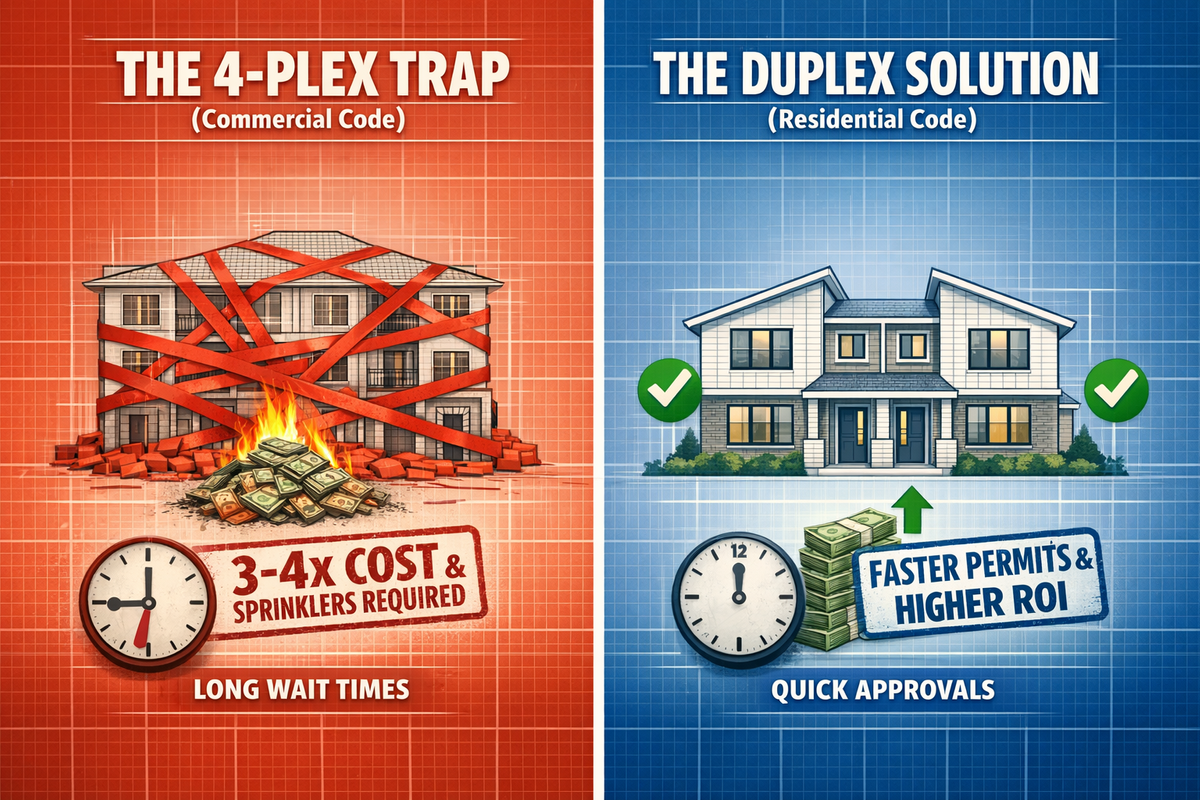
Most small Houston investors are far better off building duplexes or ADUs (accessory dwelling units) instead of 3–4‑plexes. On the surface, a 4‑plex looks like a great deal—more doors, more income, right? But behind the scenes, the bank and the City of Houston treat those projects in completely different ways, creating a hidden and expensive “financing vs. permitting” trap for builders and investors alike.[guzmanconstructionrgv]
Understanding this mismatch early can save you months of delay, thousands in unexpected costs, and a whole lot of headaches. Let’s break down why so many smart investors in Houston are stepping away from small multiplexes and turning their attention toward simpler—and far more profitable—residential strategies.
Why lenders and the City don’t see eye to eye
If you talk to a lender, they’ll probably tell you that 2–4 unit properties—including fourplexes—are “residential.” They can issue a standard residential loan, process the file under Fannie/Freddie guidelines, and get you favorable rates and terms.[mymortgageinsider] That’s great news… until you submit your building plans to the City of Houston.
Houston’s permitting department follows national building and fire codes that tell a completely different story. The moment your plans include three or more units inside a single structure, your project crosses into “commercial” multi‑family territory under the International Building Code (IBC)—not the International Residential Code (IRC) that governs single‑family homes and duplexes.[loanbase]
That means while your loan is treated as a simple home build, your permit is reviewed as if you’re constructing a full apartment complex. The result? Weeks (or months) added to approval timelines, expanded consultant requirements, and cost overruns that eat away at your returns.
The 4‑plex “commercial” surprise: what investors often miss
Once a project falls under the IBC, you trigger an entirely new category of commercial‑grade requirements that can be shocking if you’ve only built under the residential code before.[loanbase]
Investor forums are full of stories from first‑timers who ran the numbers perfectly on a fourplex—then discovered halfway through the process that their building required fire sprinklers, sealed MEP plans, and accessibility features they never budgeted for.
Common IBC‑related consequences include:
Much higher construction costs. You’re now designing a commercial structure with thicker walls, rated assemblies, and often reinforced materials.
Fire sprinklers required under NFPA‑13R or equivalent standards.[loanbase] Installation, tap fees, and potential water line upgrades can easily add $15,000–$40,000 per building.
Commercial energy compliance via COMcheck, rather than basic residential prescriptive paths, adding engineer hours and design complexity.[loanbase]
Accessibility and life‑safety upgrades like additional stairwells, wider corridors, and multi‑layer fire separations—all of which increase cost and reduce rentable square footage.[loanbase]
For most small investors, this “commercial surprise” turns what looked like a manageable infill project into something resembling a mini‑apartment development. The numbers simply stop making sense.
The permitting bottleneck: time is money
Even if you’re willing to swallow the cost jump, the City of Houston’s permitting process for small commercial buildings presents another obstacle.
Instead of moving through the faster residential review queue, your plans enter the commercial track.[loanbase] Commercial reviews tend to involve several departments—Fire, Public Works, Structural Review, and Planning—and can require multiple resubmittals to address detailed comments.
You’ll also need licensed Mechanical, Electrical, and Plumbing (MEP) engineers to produce sealed, coordinated drawings for each discipline. These professional services can easily add several thousand dollars, not to mention coordination time.[loanbase] What would have been a 6–8 week process under the IRC can now drag into six months or longer, delaying both construction and cash flow.
For small developers relying on quick project cycles and short holding periods, that delay can wipe out the profit margin before the first unit ever hits the market.
Why our team (and others) steer clear of 3–4‑plex projects
Because of this deep misalignment between residential financing and commercial permitting, many design firms—including ours—choose to stay focused on residential‑classified projects under the IRC.[loanbase]
Here’s why that makes sense:
Predictability. Residential permits move quicker, with fewer review stages and clearer code paths.[loanbase]
Manageable costs. Wood‑frame assemblies, standard detailing, and familiar trades keep bids realistic.[loanbase]
Financing alignment. Your loan expectations and permitting workflow finally match—no more being caught between residential loans and commercial rules.[mymortgageinsider]
In short, we’ve seen too many investors get trapped in projects that look small on paper but behave like large commercial builds once the city steps in. Saying “no” to those jobs protects both our workflows and our clients’ balance sheets. It’s not a limitation—it’s a smarter business choice.
The smarter pivot: duplexes and ADUs
So what’s the alternative?
Duplexes and ADUs give Houston investors the best of both worlds: residential designation, simpler construction, faster permits, and strong income potential.[guzmanconstructionrgv]
Under the IRC, duplexes are defined as two‑unit structures, which means:
They remain fully residential under both city and lender definitions.[mymortgageinsider]
They avoid mandatory fire sprinklers or ADA accessibility requirements for small projects.[loanbase]
They move through permitting in weeks instead of months.
They require fewer consultants and carry lower soft‑cost overhead.
ADUs—garage apartments, backyard cottages, or secondary homes—fit the same category, offering extra rental income or flexible multigenerational living without crossing into the commercial code world.
From an investment perspective, the math is surprisingly compelling. Between FHA, VA, and conventional multifamily‑capable loans, investors can often achieve excellent leverage and lower down payments on two‑unit properties.[mymortgageinsider] Combined with manageable building costs and shorter schedules, duplexes frequently outperform their 3–4‑unit counterparts on both yield and stability.
And if you’ve already purchased land expecting to build a 4‑plex, don’t worry—it’s often possible to redesign into two detached duplexes.[mymortgageinsider] You’ll still end up with four rentable units, but you’ll remain safely within residential territory, skip commercial permit delays, and gain faster lending approval.
It’s an elegant workaround that many experienced Houston investors now treat as standard practice.
Before you buy: safeguard your project with a feasibility study
Smart investors know that profitability begins with due diligence—not demolition. Before making an offer on a promising parcel marketed for “multifamily development,” order a feasibility study that checks zoning, setbacks, parking requirements, and most importantly, code classification.[loanbase]
A solid feasibility review should answer:
Can a duplex or combination duplex + ADU fit inside the lot’s allowable footprint while meeting all height, setback, and parking limits?[loanbase]
When would a third or fourth unit trigger IBC commercial requirements like fire sprinklers, ADA compliance, and COMcheck energy modeling?[loanbase]
Does your chosen financing strategy still make sense after factoring in the higher construction, design, and permit costs of a “commercial” 4‑plex?[guzmanconstructionrgv]
Our team often adds a layer of value by creating a comparative pro forma—side‑by‑side modeling of a fourplex vs. two duplexes on the same site.
By answering these questions before closing, investors can proactively avoid the pitfalls that sink many small development projects. A tiny upfront cost for expert analysis can prevent six‑figure mistakes later.
Final thoughts: build smart, not big
Houston’s infill housing market is booming, but opportunity only favors those who understand how lending rules and building codes intersect. The 4‑plex “trap” catches countless first‑time and even mid‑level investors each year—not because their math was wrong, but because the system itself is mismatched.
By staying inside the residential lane with duplexes and ADUs, you keep your financing, code, and timeline perfectly aligned. You spend less time waiting on permits and more time collecting rent.
If you’re planning a new build or evaluating a property for residential investment, reach out for a feasibility consultation before locking in your design or offer. We’ll help you identify the best path—whether that’s a duplex/ADU combination, a creative site split, or an efficient phased build plan that stays profitable from day one.
In today’s Houston market, smart investors aren’t chasing more units—they’re chasing better returns with fewer surprises.